one manager or administrator for every five employees, and much of their time goes to running the organization. The best-run companies carry half that burden.
Hamel & Zanini · HBR · 2016 · Bain
The operating system for team-based companies
Run your company as teams.
Orchestre connects structure, strategy, delivery, requests and skills in one model of how your organization really works. Every team knows its mission. Every goal traces to the work. Leadership sees it all.
Why hierarchies fail
You hired great people and set a clear strategy. So why does your company feel so heavy?
Slow to decide, expensive to run, hard to change and late to innovate. Decisions are made in the room and still haven’t happened three weeks later. It isn’t your people. It’s the machine around them: as a company grows, the hierarchy grows with it, with more layers, more approvals and more reporting, while the work itself runs across teams.
of the average company’s productive capacity is lost to organizational drag: the meetings, approvals and procedures the structure creates.
Mankins & Garton · Bain · 2017employees say new ideas meet indifference, scepticism or resistance in their organization.
Hamel & Zanini · 2018of employees work across more than one team, while the org chart still shows a single line per person.
Gallup · 2016The middle grows, and runs the machine.
Each new layer adds coordination, reporting and sign-offs. More and more people end up running the organization, reporting, coordinating and administering, instead of doing the work that creates value, and the cost grows with every hire. The best-run companies work with spans twice as wide, and carry half that burden.
The structure stiffens.
Every question that crosses a reporting line climbs the hierarchy and comes back down. The company moves at the speed of its busiest executives, and new ideas wait for permission.
The work crosses the boxes.
People contribute to several teams and projects at once, but the structure only knows their reporting line, so nobody can see who actually does what, and hand-offs between teams wait in inboxes, unowned.
Reorganising doesn’t fix it.
Fewer than a quarter of redesigns fully succeed (McKinsey, 2015). Redrawing the boxes leaves the way work flows between them unchanged.
The proof
Organised around teams, they moved faster.
The organisations that broke the hierarchy’s limits rebuilt themselves as networks of small, accountable teams, with decisions taken close to the work.
4,000 teams
Haier split into micro-enterprises of 10 to 15 people, with two layers between the front line and the CEO, and grew revenue 18% a year for a decade.
HAMEL & ZANINI · HBR · 20184 → 10,000
Buurtzorg grew from four nurses to about ten thousand in self-managed teams, supported by an office of about fifty, with a third fewer care hours per patient.
BUURTZORG · KPMG · 201518 → 300
Operations a month for General McChrystal’s task force, once rebuilt as a “team of teams”.
S. MCCHRYSTAL · TEAM OF TEAMS · 2015Across industries, the most successful moves to teams report gains of around 30% in efficiency, customer satisfaction and employee engagement, and organizations five to ten times faster (McKinsey Global Survey, 2021). The direction is clear. Getting there is the hard part.
Why they stall
Most team-based transformations stall, for the same reasons.
of companies feel very ready for team-based structures; 6% feel very effective at managing cross-functional teams.
Deloitte Human Capital Trends · 2019had completed an agile transformation across the whole company.
McKinsey · 2017of Zappos employees took a buyout rather than work under self-management. Medium later dropped the same model.
Fortune · 2016“Even at the time we wrote it, we weren’t doing it.”Joakim Sundén, co-author of the Spotify model · quoted by Jeremiah Lee, 2020
The model that inspired a generation of reorganisations was never fully run by the company that described it. The idea was right; the system to run it was missing.
- ×The structure becomes invisible.Nobody can see who is in which team, with what role. One firm’s network analysis found 4 real working teams behind 14 formal structures.
- ×HR systems know one reporting line.Careers, reviews and pay follow the hierarchy, while the work happens across several teams.
- ×Goals don’t map to teams.Without team-owned goals on a shared cycle, autonomy turns into misalignment.
- ×Dependencies go unmanaged.Teams block each other without anyone seeing it until a deadline slips.
- ×Governance is missing, or bureaucratic.Either nobody knows who decides, or every responsibility is codified until the process becomes a tax.
The few that made it work built their own operating system.
Buurtzorg
BuurtzorgWeb carries the planning, records and results of its self-managing nursing teams.
Haier
A contract and accounting platform links thousands of micro-enterprises without reporting lines.
Spotify
Built Backstage to know which team owns what across its autonomous squads.
U.S. Task Force
A daily operations and intelligence forum gave every team the same picture of the whole.
Sources: G. Hamel, M. Zanini, “Excess management is costing the U.S. $3 trillion per year”, Harvard Business Review, 2016 · Bain & Company, “Streamlining spans and layers”, 2010 · M. Mankins, E. Garton, Time, Talent, Energy, Bain / HBR Press, 2017 · G. Hamel, M. Zanini, “What we learned about bureaucracy from 7,000 HBR readers”, 2017, and Humanocracy research, 2018 · Gallup, “Matrix teams gaining greater power in companies”, 2016 · D. Sull, R. Homkes, C. Sull, “Why strategy execution unravels”, Harvard Business Review, 2015 · McKinsey, “Getting organizational redesign right”, 2015 · McKinsey, “Decision making in the age of urgency”, 2019 · Deloitte Global Human Capital Trends, 2019 · McKinsey, “How to create an agile organization”, 2017 · Fortune, Jan. 2016 (Zappos) · J. Lee, “Spotify’s failed #SquadGoals”, 2020 · G. Hamel, M. Zanini, “The End of Bureaucracy”, Harvard Business Review, 2018 (Haier) · Buurtzorg, and KPMG for the Dutch Ministry of Health, 2015 · S. McChrystal, Team of Teams, 2015 · McKinsey, “The impact of agility”, 2021.
The answer
Orchestre is that operating system, ready for every company.
One live model of how your organization really works: teams, roles, goals, decisions, commitments and skills. Everything attaches to the team, so the organization can change as fast as the business without losing sight or control. And Orchestre carries the coordination that layers of management used to absorb, who owns what, who decides, what is blocked, so fewer people run the machine and more people do the work.
01
Teams are first-class. Permanent, cross-functional and project teams live in one structure, with leaders, deputies and members.
02
Everything attaches to a team. Goals, actions, projects, tasks, requests and skill targets all belong to a team, so reorganising moves them with it.
03
Rights follow the structure. Who can see, decide and approve comes from each person's roles, everywhere, including for AI.
Structureteams, roles, projects
GoalsOKRs, actions, budgets
Deliveryprojects, plans, risks
Requeststicket desks, dependencies
Skillstargets, gaps, approvals
AIanswerable, governed
Inside Orchestre
Six systems on one model, so each makes the others work.
Separate tools can’t answer the reasons team-based organisations stall, because none of them knows how the company is organised. In Orchestre, goals, projects, requests and skills all run on the same model of teams and roles.
01 · THE ORGANIZATION MODEL
Your organization, as it really works.
A team-based company can’t be described by a reporting chart. People work in several teams, projects come and go, and responsibilities sit with teams rather than boxes. Orchestre starts by modelling that reality, because everything else depends on it.
How it is built
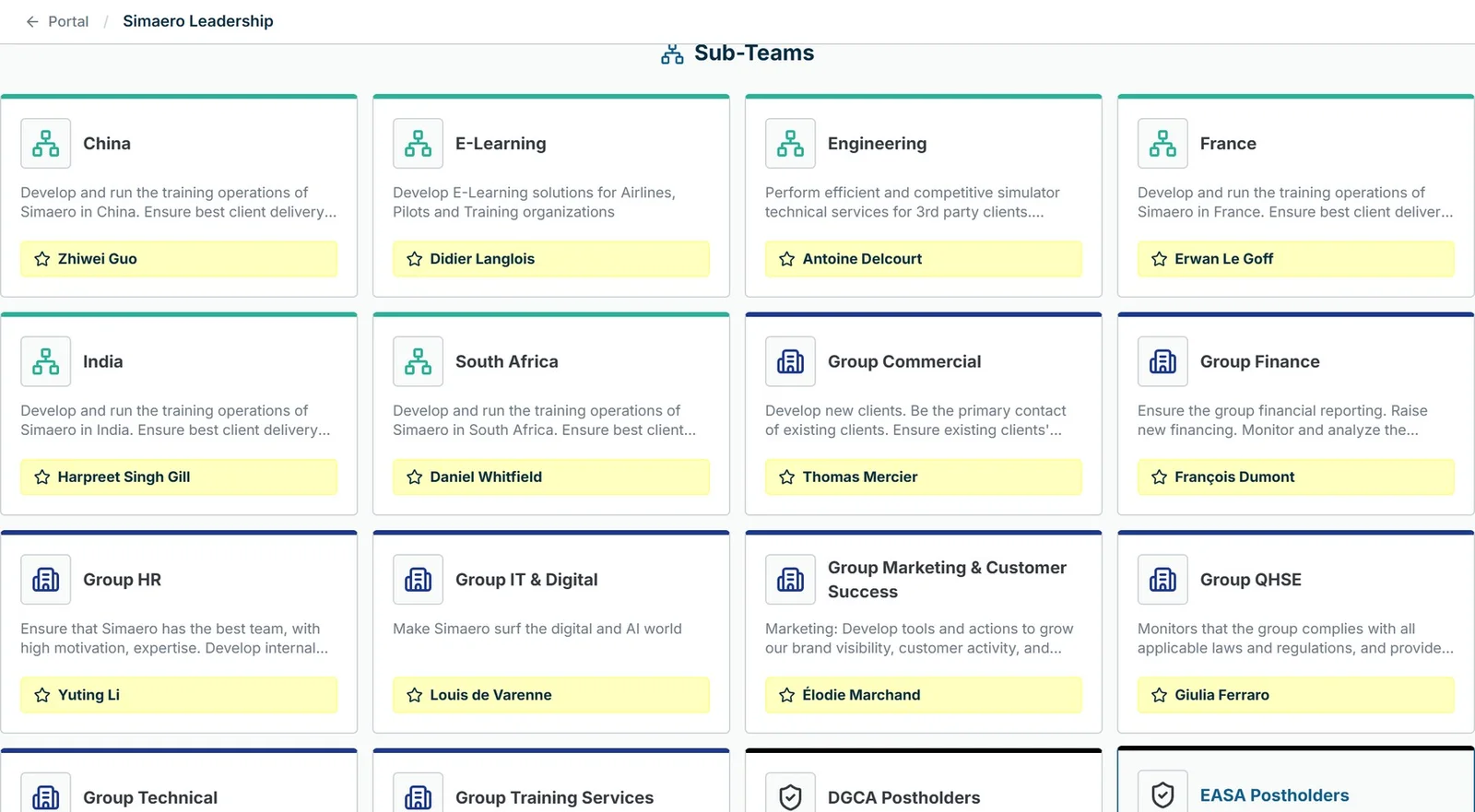
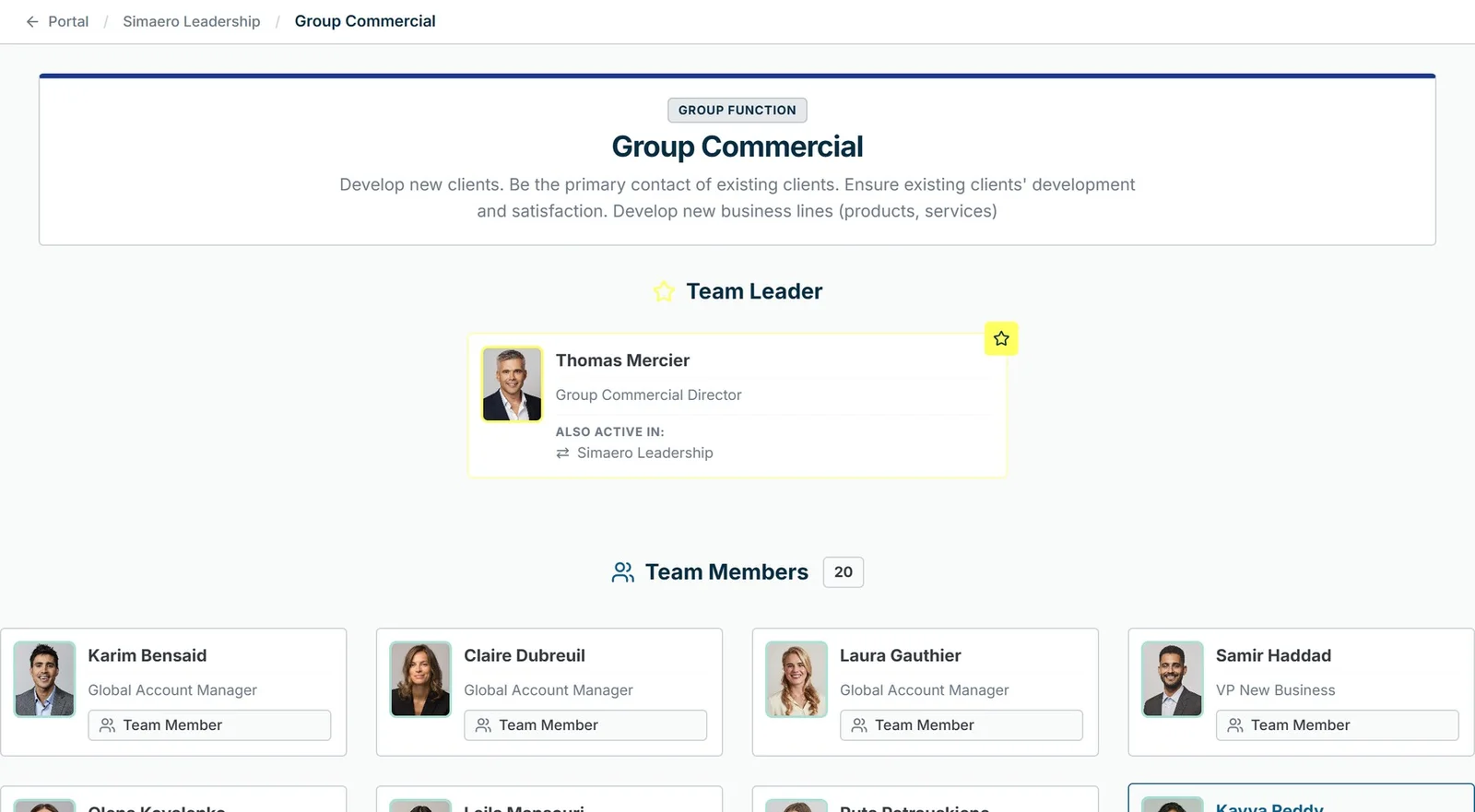
- Teams as the unit of the company.Permanent teams (business units, functions), project teams and compliance teams live in one structure, each with its mission, a Team Leader, deputies and members.
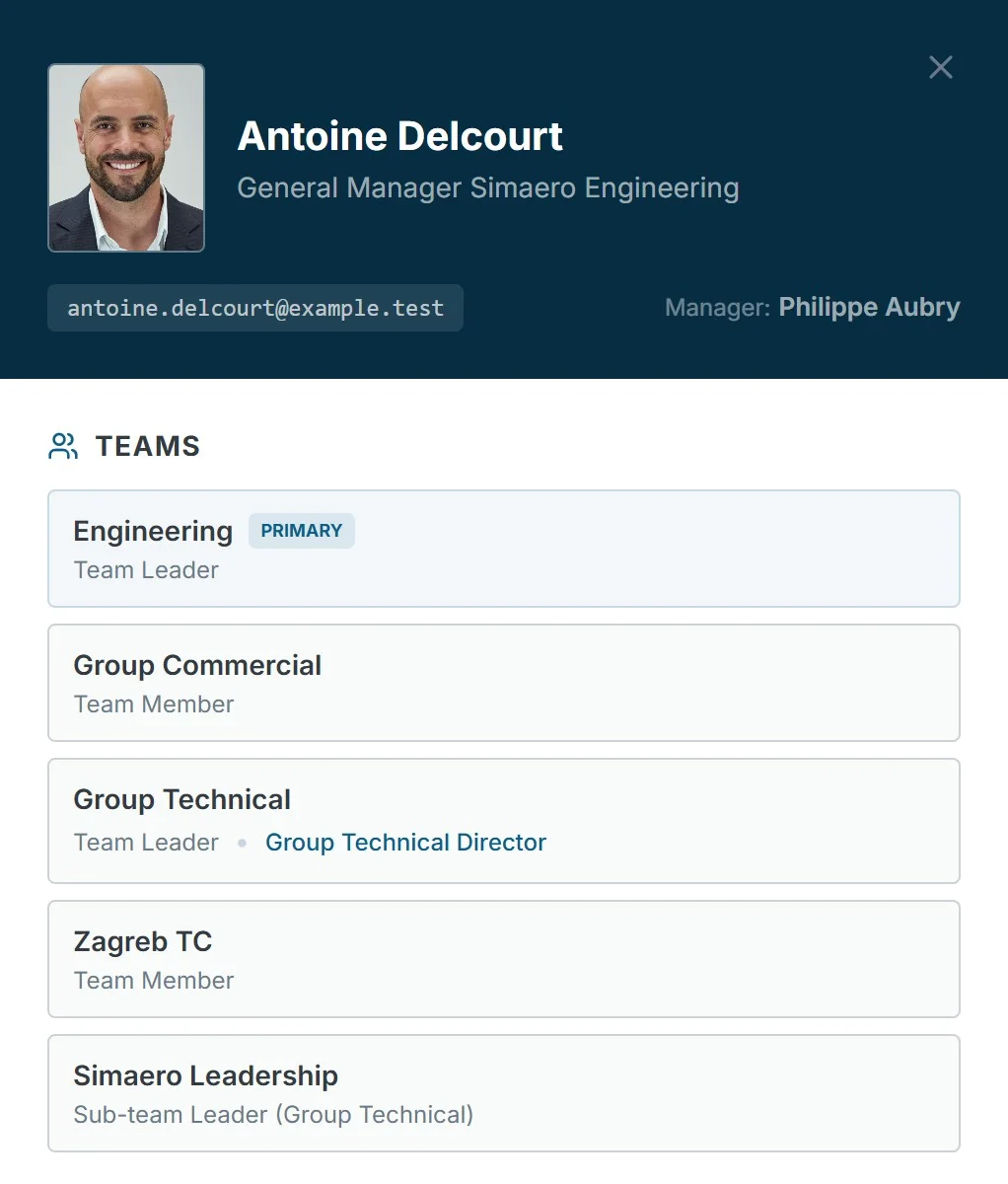
- A role in every team.Each person belongs to every team they actually work in, with a role in each: leader, deputy, senior member, member or temporary. Role specs describe what they are responsible for there.
- One manager for the career.Separately, each person keeps one manager who handles their development, skill approvals and personal details. Leading the work and developing the person are two distinct jobs.
- Leaders link the levels.The leader of a sub-team automatically sits in the team above, so every level of the organization is connected through its leaders.
- Each team publishes how to work with it.A team page says what the team does, how to ask it for something and who to contact, the operating manual a newcomer needs.
Why it works better integrated
Because goals, projects, requests, skills and one-to-ones all hang on this model, it is never a decorative chart that drifts out of date. It is the map the work runs on. When the organization changes, you edit the model, and everything the team owns stays attached to it. And because anyone can see each team’s mission and roles, people go straight to the right person instead of up and down a hierarchy.
02 · A COMPLETE OKR SYSTEM
Strategy, from long-term goals to this quarter’s actions.
Most companies set objectives once a year and lose track of them by spring. Orchestre provides the full architecture of an OKR system, from the company’s long-term goals down to what each team commits to this quarter, with the governance that keeps it honest.
The architecture
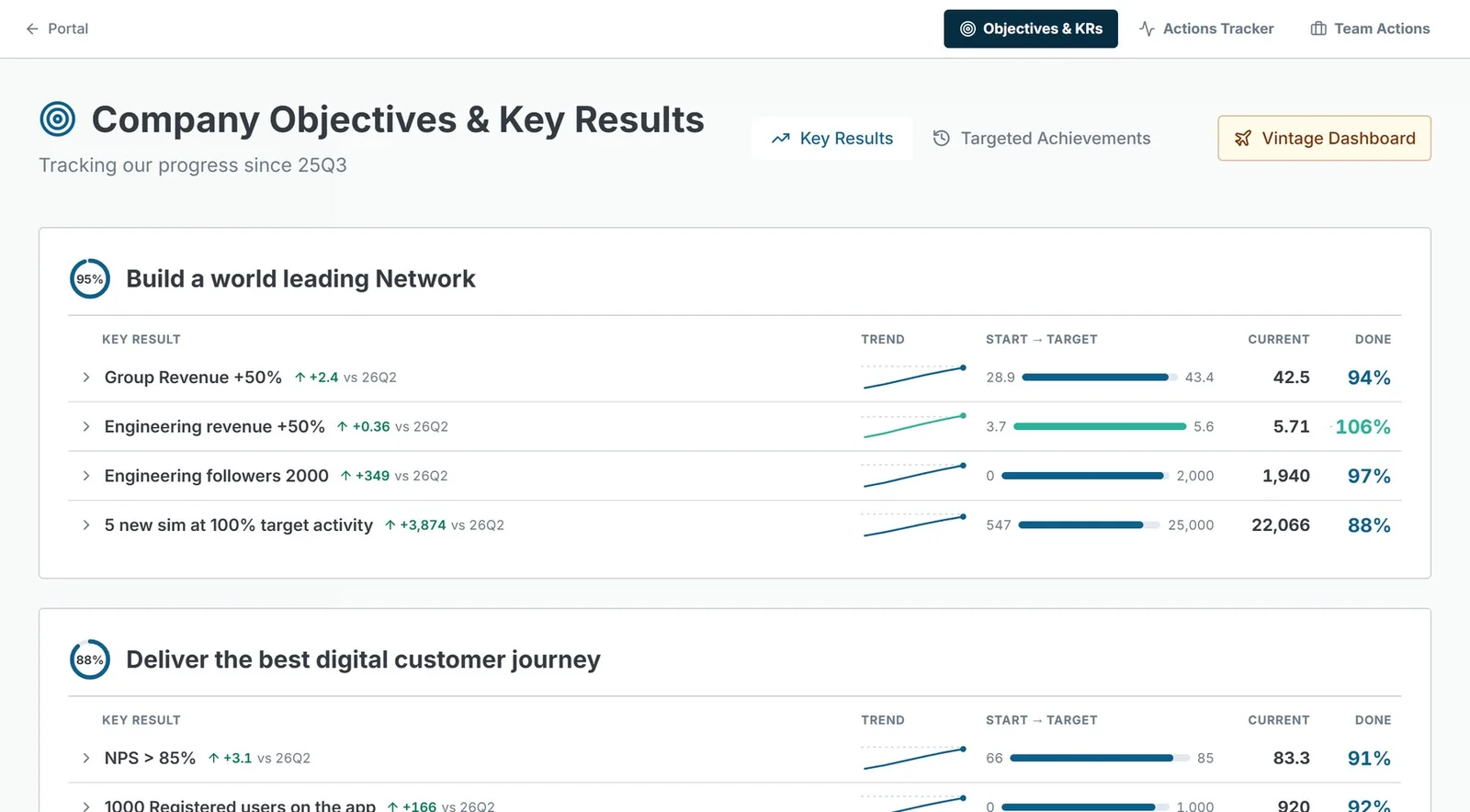
- Company objectives.A few strategic objectives, up to five, that frame the company’s direction over several years.
- Key results, measured every quarter.Each objective is broken into measurable key results with a start value, a target and a value recorded every quarter, so progress and trends are visible at a glance.
- Targeted achievements.Qualitative milestones that matter as much as the numbers, such as a launch, an opening or a certification, tracked alongside them.
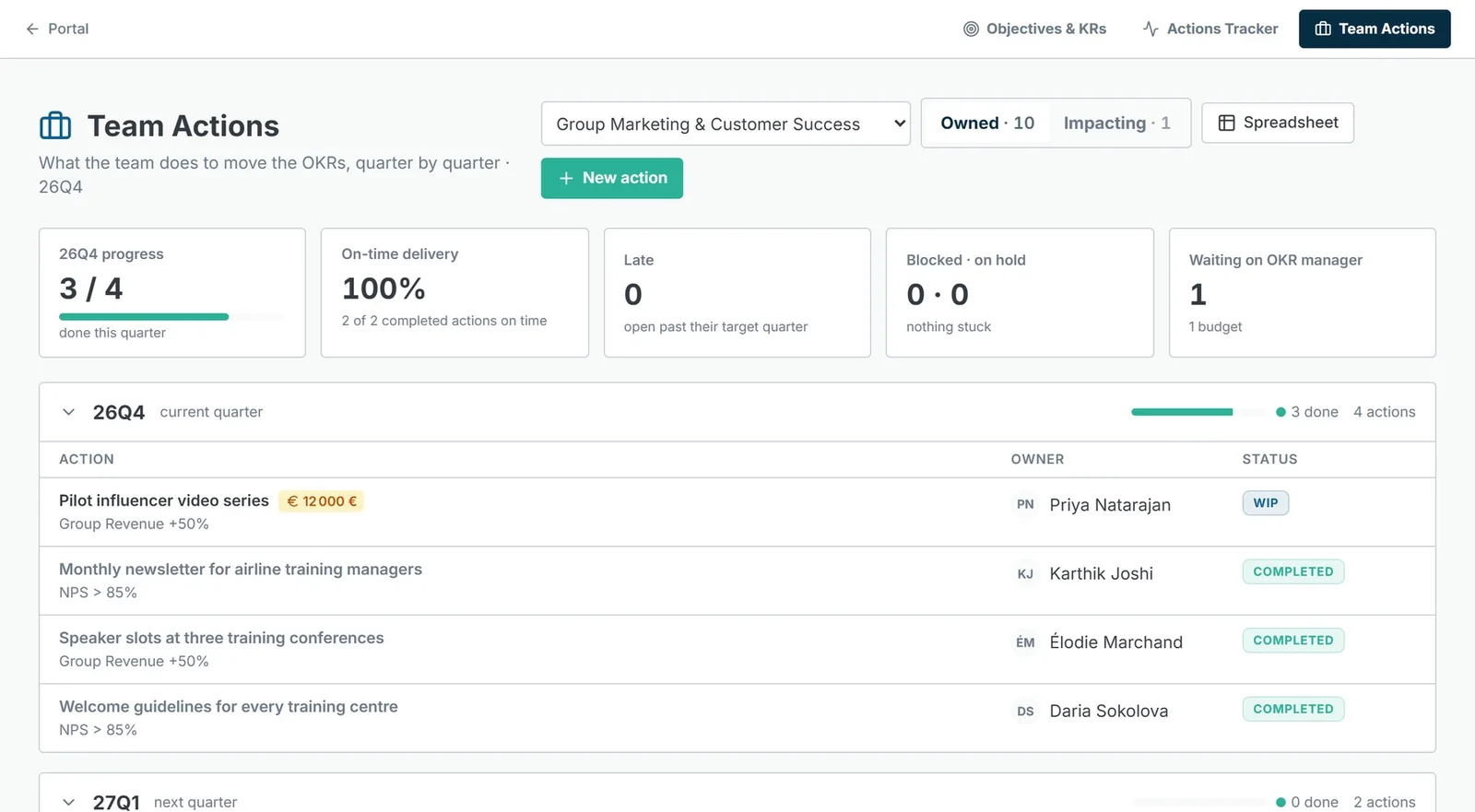
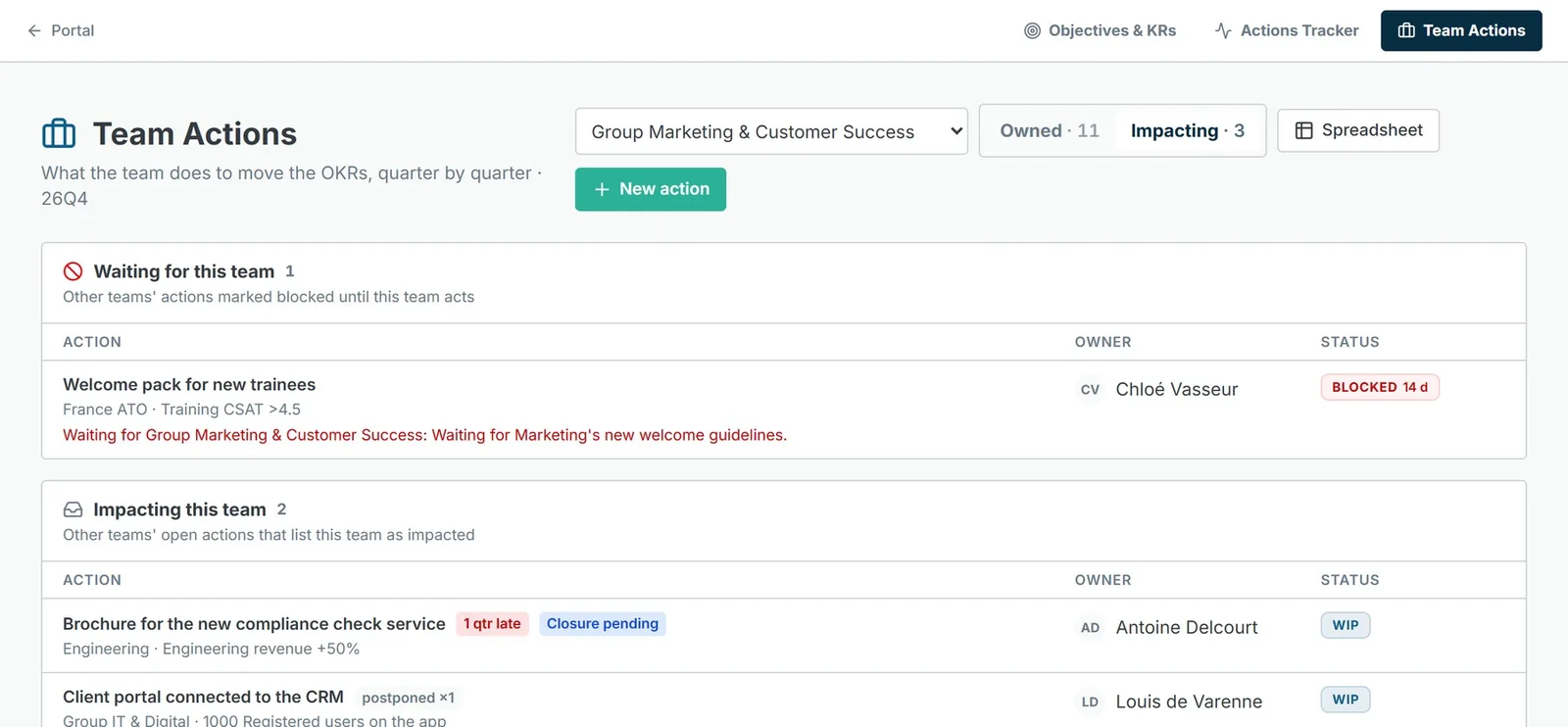
- Team actions, planned by quarter.Teams commit to actions for a given quarter, each linked to the objectives and key results it serves, with an owner, the other teams it affects and, if needed, a budget request in opex or capex.
- A governance cycle.Owners keep the status current, and a blocked action names the team it waits for. Team leaders ask for new target dates and propose closures with a justification; OKR managers decide. Every change is recorded against the original commitment, and a review page gathers all pending decisions and budgets.
Why it works better integrated
Because actions belong to teams, each Team Leader runs the quarter on one page: what the team committed to, what is late, what is blocked, what waits for a decision. Teams see the actions of others that affect them. Actions can be created during a one-to-one and appear on the right dashboards. On-time delivery is measured against the quarter first committed, so postponing never looks like progress, and leadership sees strategy turning into work, team by team, without asking for a status deck.
03 · PROJECTS RUN AS TEAMS
Projects inside the organization.
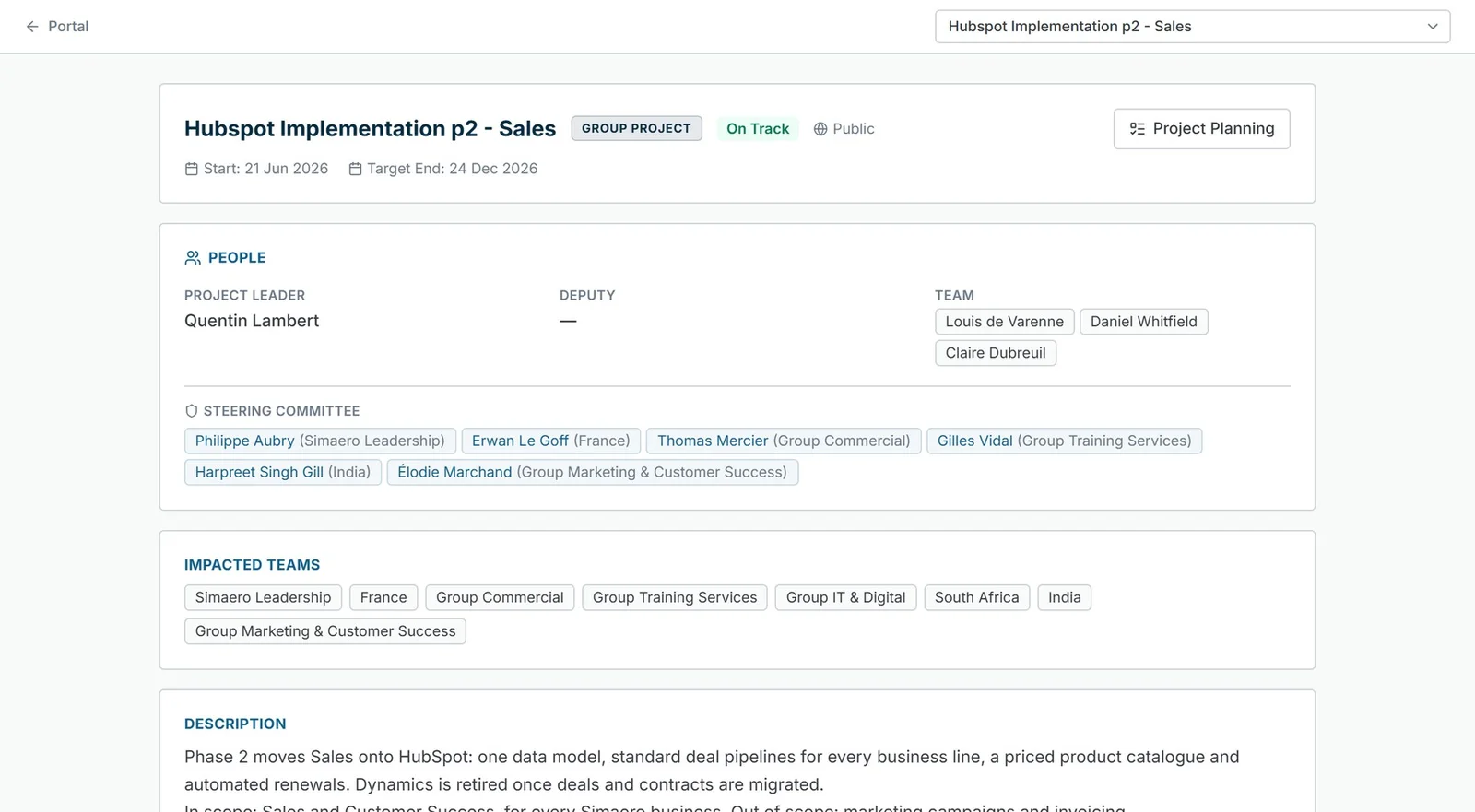
In most companies, projects live in a separate tool that knows nothing about the organization: who sponsors them, which teams they disrupt, who should oversee them. In Orchestre, a project is a team inside the structure, with its governance and its plan.
How it is built
- A project is a team.Launched at the top, it can draw on anyone. Launched inside a department, that department’s leader becomes its sponsor and it is staffed with the department’s people, who keep their place in their own teams.
- Visible across the company.Everyone can see who works on which project, and each person’s project work sits next to the rest of their commitments, on their dashboard and in their one-to-ones.
- Overseen by the teams it affects.Declare which teams the project affects, and their leaders form its steering committee, which follows them when a team changes leader.
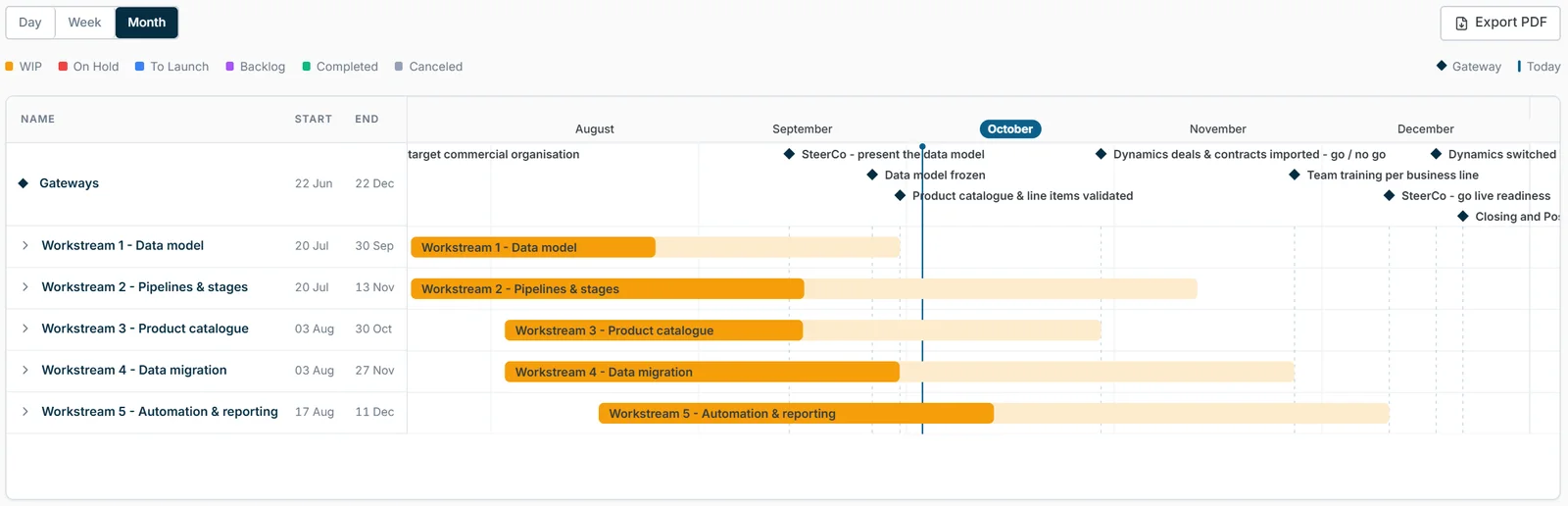
- Governed from kick-off to closure.Gateways mark the decisions from kick-off to the closing review, with a risk register scored before and after mitigation.
Why it works better integrated
Because projects sit inside the same model as the organization, the teams that will live with the outcome oversee a project from its first gateway instead of discovering it at the end. Its people stay visible in their own teams, so their leaders see the whole load they carry, and the project’s work is part of the same dashboards, one-to-ones and goals as everything else.
04 · FLOW BETWEEN TEAMS
Dependencies and requests, in the open.
As a company grows, most delays sit between teams rather than inside them: an action waiting for another team, a request lost in an inbox, a hand-off nobody owns. Orchestre turns those links into information both sides can act on.
How it is built
- Identify blocking interactions.When an action is blocked, its owner records which team it is waiting for and why. That team sees what it is holding up on its own page, and its leader can be contacted in one click.
- Impact made visible.Actions that affect another team appear on that team’s page and on its leaders’ dashboards.
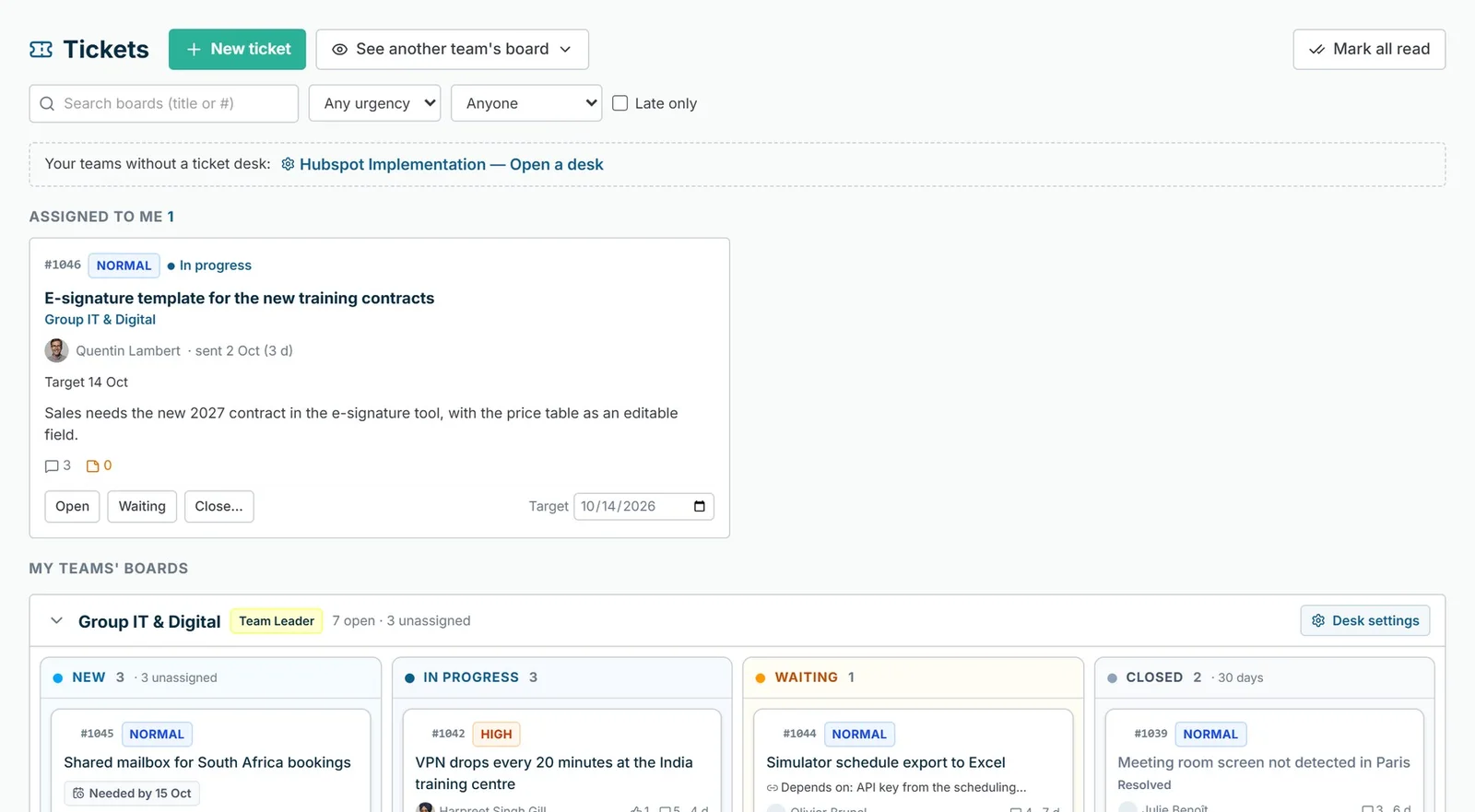
- A desk for every team.Any team can open a ticket desk run by its leaders and the members it designates. Requests arrive on a board with a public discussion and an internal one.
- Commitments, not wishes.The desk assigns an owner and commits to a date, set against the date the requester needs. Requests nobody picks up trigger reminders, sooner for urgent ones.
- Hand-offs that keep their history.A request can be transferred to another team with its internal discussion, and duplicates follow their main request.
Why it works better integrated
Because Orchestre knows which team owns what, a request goes to the right team rather than to whoever someone happens to know, and a blocked action is a link between two teams that both can see. People change roles without taking the knowledge of open requests with them. What used to surface as an escalation now shows up early, as data, while there is still time to act.
05 · CAPABILITY PER TEAM
The skills each team needs, and the gaps that put plans at risk.
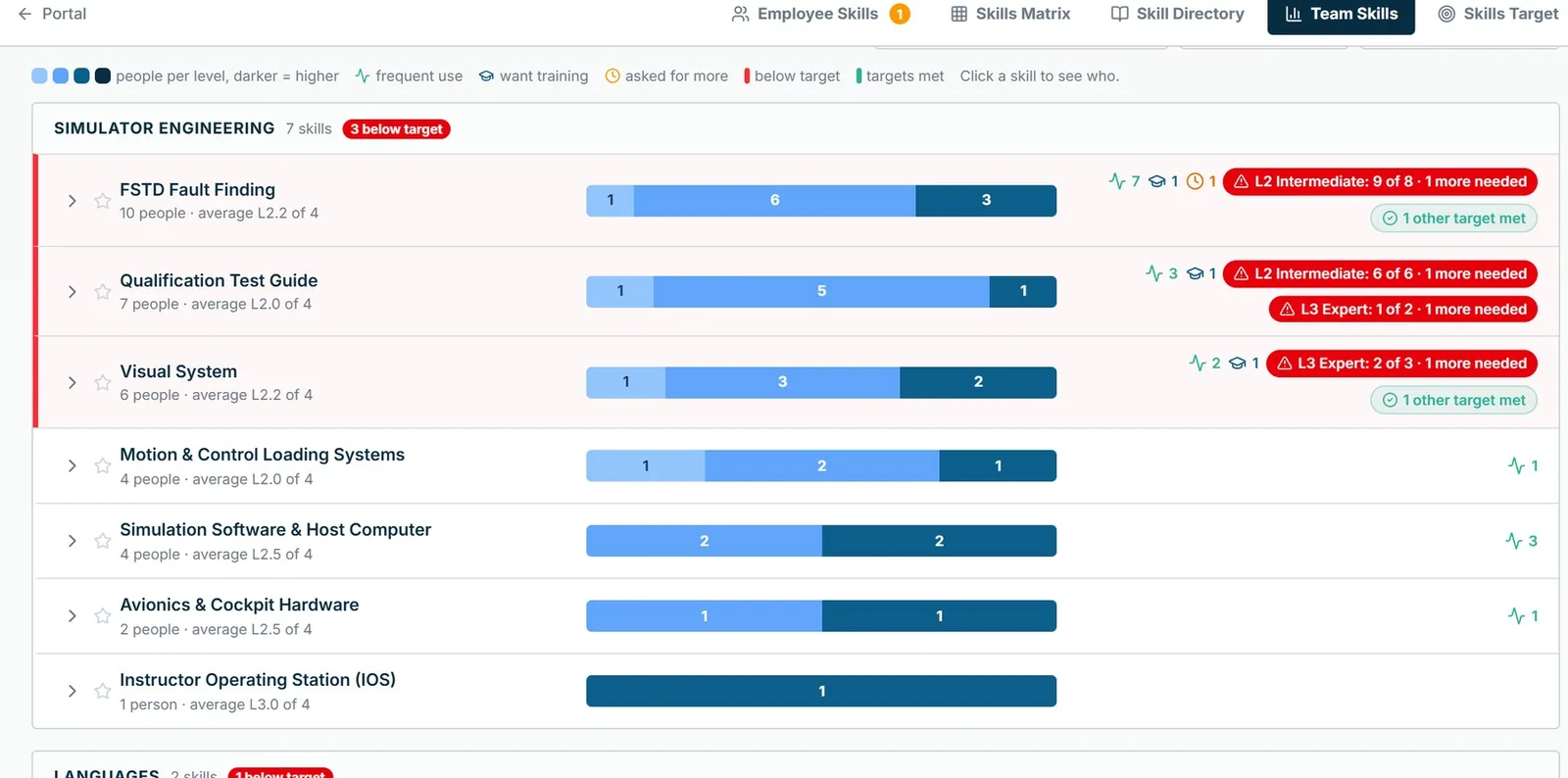
Most companies discover a missing skill when a project stalls or a key person leaves. Orchestre lets each team state the expertise it needs and compares it continuously with what its people actually have.
How it is built
- A shared skills catalogue.Each skill has its own scale of levels, from beginner to instructor, organised by category.
- Levels people can trust.People ask for a level; their manager or team leaders approve it, with evidence and a full history.
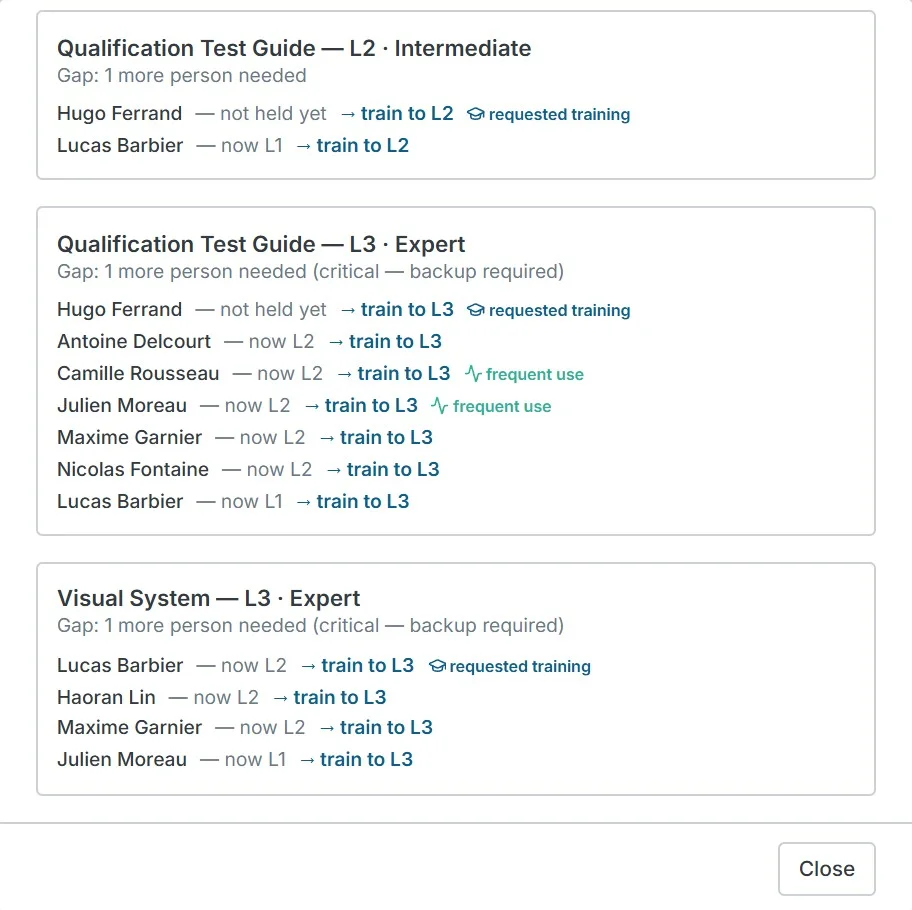
- Targets set by each team.A team defines, skill by skill, how many people it needs at each level, what everyone must master, and which skills are too critical to rest on a single person.
- Gaps, backups and single points of failure.Orchestre compares targets with approved levels and flags shortfalls, missing backups and skills held by one expert.
- A plan to close them.A training proposal lists who is closest to each missing level and who has asked to learn it, with reports for audits and customers.
Why it works better integrated
Skills platforms attach requirements to job titles. Orchestre attaches them to the teams that carry the goals and projects, so gaps show up exactly where they put work at risk. Sub-team leaders count in the team above, approvals happen in one-to-ones, and anyone can find the expert they need in seconds.
06 · LEADING PEOPLE
Tools to lead people, not files.
Team leaders in a networked company lead several teams and projects at once, and managers develop people they don’t always work with. Both need what people have committed to and how they work, in one place, and right where they already spend their day.
How it is built
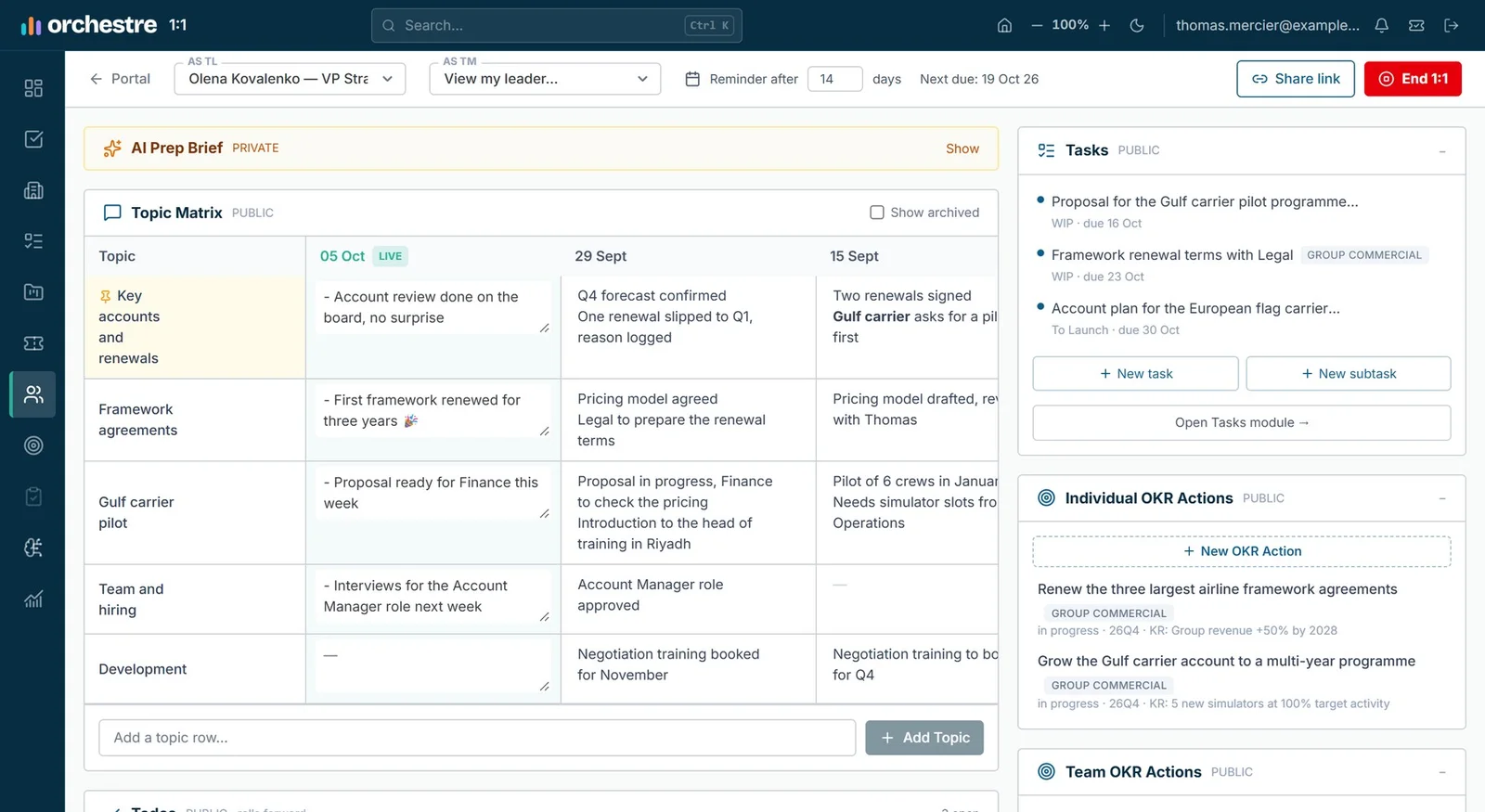
- One-to-ones that follow through.Topics run as rows and meetings as columns, so each conversation picks up where the last one ended. The team member follows live; the leader’s notes stay private.
- Every commitment in one place.The person’s OKR actions, project tasks and agreed to-dos are gathered for each meeting, and agreed actions roll forward until done, on both people’s dashboards.
- Continuous 360° feedback.Colleagues from every team the person works in give anonymous feedback over the year, summarised for their manager as factual input to each appraisal.
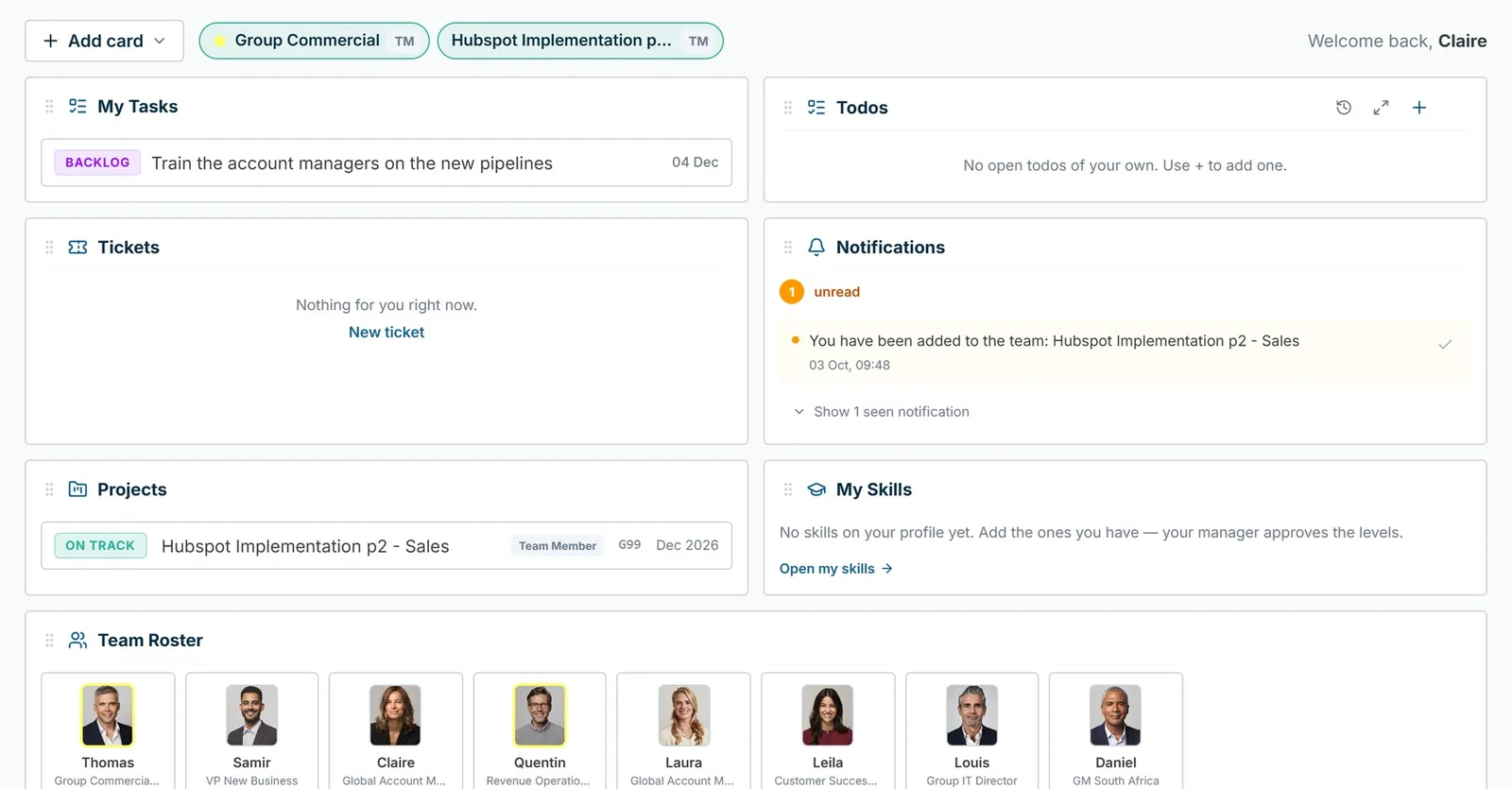
- One view per person.Each person and each leader starts on what needs them across all their teams: tasks, actions, requests, projects and skill gaps.
- In the corporate chat.Through corporate chats like Microsoft Teams, notifications arrive in the conversation, and anyone can check a team, a colleague or their own tasks without leaving it.
Why it works better integrated
Because one-to-ones, feedback, dashboards and the chat read the same model as goals, projects and skills, leaders don’t assemble their picture from five tools. The commitments discussed come straight from the real goals and projects, the feedback comes from every team the person works in, and the decisions taken become work the rest of the organization can see.
Why nobody else does this
Every tool covers a slice. None models the team-based company.
Most companies run their organisation across five kinds of software. Each is good at its job, and each assumes something a team-based company has left behind.
| Category | What it does well | What it can’t do for a team-based company |
|---|---|---|
| HR systems | Employees, contracts, pay, the reporting line | Model one supervisory line; membership in several teams is a dotted-line add-on, a workaround or missing |
| Org chart & design tools | Visualise and plan the structure | Describe the organisation without running it: no goals in execution, projects, requests or decision rights |
| OKR software | Objectives, key results, check-ins | Treat “team” as a label; no structure, no decision rights on targets, often no link to budgets or projects |
| Work management | Tasks, boards, timelines | Teams are permission containers; no career line, roles, skills or governance |
| Self-management tools | Circles, roles, governance records | Tied to one methodology, usually without the HR line, budgets or skill targets |
| Orchestre | One team object that structure, goals, governance, requests and skills all run through, with the career line kept separate and every action governed by each person’s rights | |
08 · Intelligence
One model. Instantly answerable.
Because the whole organization lives in one model, any AI assistant can reason over it. Orchestre doesn't lock you into its own chatbot: it lets the assistant you choose act as you, with exactly your rights.
- Bring your own assistant. Any assistant that supports the Model Context Protocol connects through a standard OAuth sign-in, after a consent screen that names it and explains that it will act on your behalf.
- Questions across the whole organization. It reads the structure, objectives, projects, skills and requests, and answers questions that would otherwise take several reports and a meeting or two.
- Actions within your rights. It can create tasks, add gateways, update actions and handle tickets, with every call checked against your own permissions, private projects and confidential teams included.
- Governance preserved. It can't close an action or move a target you couldn't move yourself, and its changes notify people exactly as if you had made them in the app.
AI assistant · connected to Orchestre
What is blocking my team's Q4 actions, and which projects are late?
→ orchestre_get_team_okrs · as you
→ orchestre_get_project_health_summary · as you
→ orchestre_get_project_health_summary · as you
1 action blocked: Post-course survey, waiting for Group IT & Digital.
Hubspot Implementation p2 · Sales is late: 2 tasks past their end date.Based only on what you are allowed to see.
Hubspot Implementation p2 · Sales is late: 2 tasks past their end date.Based only on what you are allowed to see.
ILLUSTRATION · TOOL NAMES FROM THE ORCHESTRE MCP SERVER
Sophisticated by design
The details that make it work at scale.
Deputies and delegated leads
A deputy holds the team leader's full rights, so nothing stops when the leader is away. A leader can also hand a piece of work to an owner who runs its subtasks without being able to change the goals or deadline that were set.
Notifications that resolve themselves
When anyone completes something that was asked of several people, the request clears for everyone and shows who handled it. Notifications also arrive in Microsoft Teams, where people already work.
Search that respects permissions
One search covers people, teams, projects, tasks, requests, objectives and skills. Results are filtered for each viewer, so finding things never means seeing what you shouldn't.
A dashboard for each role
Team leaders start on what needs their attention across all their teams: work in progress, skill gaps, actions affecting them, and a summary of every project they lead.
Routines that run themselves
Recurring work, such as a monthly close or a quarterly review, is saved once as a template with its subtasks and owners, then created automatically on schedule.
Compliance reporting lines
Regulated functions such as safety or quality can keep their own reporting line inside the team, without distorting the main organization.
Projects that close cleanly
A project can be archived only once its work is finished and its requests are closed. It then stays readable as a record, and can be reopened if needed.
Board-ready reports
Gantt, Kanban and task reports come straight from the live plan, ready for steering committees and boards. Skill reports export to PDF and Excel.
Native to Microsoft 365
Microsoft sign-in, notifications in Teams, and one-click Teams conversations with the right team leader, with the context already written.
Rollout
From org chart to operating system.
We help you design the team architecture, then the platform carries it day to day.
Design your teams
Map the company into accountable teams with clear missions, leaders and deputies, and decide where projects live.
Connect the work
Load the organization, set company objectives, open ticket desks and skill targets. Your teams start from a model of how you really work.
Run and improve
Leaders run their teams, OKR Managers govern the strategy, and the whole company becomes visible, and answerable.
Your teams are ready to play. Give them a conductor.
See Orchestre on your own organization. A 30-minute walkthrough with the team that built it.
Book a demo
hello@orchestre.app